
Did Washington Post amplify Moroccan propaganda?
Washington Post echoes disputed claims that Saharan mercenaries were captured in Aleppo
On April 12, 2025, the Washington Post published a story describing the new Syrian government’s alleged efforts to dismantle illicit Iranian supply lines running through southern Syria. These supply lines had operated out of Syrian military bases kilometers from the disputed Golan Heights with the oversight of Iranian military advisors, largely to aid Hezbollah in their war against Israel.
Thirty paragraphs into their Page One story — as an aside — reporters Loveday Morris and Souad Mekhennet implicated soldiers from an Algerian-based nationalist movement in the Iran-Hezbollah conspiracy. “Iran, for instance,” they wrote, “trained fighters from the Algeria-based Polisario Front, a militant group fighting for the independence of Western Sahara from Morocco,” adding that “hundreds” of these fighters were “now detained by Syria’s new security forces.”
As this TruthAfrica investigation shows, the central pieces of evidence for these allegations appear to be a distortion of an Algerian ambassador’s statements and an inauthentic document that first appeared, in 2023, on a Facebook page celebrating the Moroccan Armed Forces. In fact, there appears to be no independently verifiable evidence to support the claim that any Iranian-backed Polisario Front soldiers were captured in Aleppo and held prisoner by the new Syrian regime. TruthAfrica is a collaboration between Pravda Association and Code for Africa.
Despite, as TruthAfrica shows here, the shaky ground on which this claim rests, its origin in Moroccan media, and its amplification by pro-Israel or anti-Iran pundits and politicians, the assertion is already being cited by powerful political forces as a reason to designate the Polisario Front a terrorist group, to tie Algeria to Iran, and to hand Western Sahara over to Morocco in contravention of a UN peacekeeping agreement.
Post reporters Morris and Mekhennet did not respond to our request for comment made by email on May 22, 2025. In a statement published after their story’s initial publication, the Polisario Front denied the allegation of any ties to Iran, saying that to “suggest that Polisario fighters would abandon their decades-long struggle against Moroccan occupation in favor of distant conflicts in which they have no stake is not only implausible — it is an insult to the dignity and determination of a people fighting for their freedom.” The Polisario Front did not respond to TruthAfrica’s request for comment.
“Africa’s Last Colony”
Western Sahara is a region on the west coast of Africa claimed by both the Kingdom of Morocco and the Sahrawi Arab Democratic Republic (SADR), an entity recognised by a slim minority of UN member states. Rich in natural resources like phosphate rock, which is used in fertiliser, most of Western Sahara has been under de facto control of the Moroccan government since its military began occupying the region in 1975 following the withdrawal of Spanish colonial forces.
The Polisario Front, short for the Popular Front for the Liberation of Saguia el-Hamra and Río de Oro, was formed in 1972, initially to resist Spanish colonisation in Western Sahara on behalf of the Sahrawi people, the region’s indigenous inhabitants. After the withdrawal of Spanish forces in 1975, Mauritania, Morocco, and the Polisario Front each invaded the region. Mauritania gave up its claim a year later, at which point the Polisario founded the SADR.
The Polisario Front have been at war with Morocco, exclusively, since 1976. A 1991 ceasefire agreement froze the major boundaries of the conflict as they stand today, with approximately 20% of Western Sahara under Polisario Front control and the remaining controlled by Morocco. While Morocco is the de facto authority in the region, the UN views Western Sahara as a Non-Sovereign Territory since 1963, defined as “territories whose people have not yet attained a full measure of self-government.”
The Moroccan government considers the region part of their territory and regard the Polisario Front as a separatist group guilty of terrorism. Algeria, the SADR’s neighbour and chief sponsor, views the Polisario Front as the rightful government presence in Western Sahara. The UN’s view is that Spain never had the unilateral authority to give Western Sahara to any nation. Human rights experts, political scientists, and the Polisario itself have described Western Sahara as ‘Africa’s last colony.’
While the UN does not recognise the SADR as a sovereign territory, the UN does recognise the Polisario Front as the legitimate representative of the Sahrawi people. The Polisario Front have embassies in a handful of countries, including South Africa and Cuba, engage in foreign policy, direct the SADR’s military efforts, and govern in the area under their control. The Polisario Front’s government-in-exile is located in and supported by Algeria, where refugee camps hold those displaced by the conflict.
The 1991 ceasefire agreement established a UN peacekeeping force in Western Sahara and mandated holding a referendum on the sovereignty of Western Sahara at a future date. To this day, there has been little to no progress implementing such a referendum and Morocco has engaged in heavily lobbying its allies to reject the Polisario Front’s claims, often by labelling them as a terrorist group tied to Iran.
In 2018, Morocco broke off diplomatic relations with Iran. Their stated reason was Iran’s alleged support for the Polisario Front. Morocco’s foreign minister claimed that intelligence suggested that Iran had supplied weapons to the Polisario via Hezbollah. The move brought Morocco closer, diplomatically speaking, to the West and to the Gulf Council States of Bahrain, Kuwait, Oman, Qatar, Saudi Arabia, and the United Arab Emirates.
When Morocco first alleged that Hezbollah and Iran had supported the Polisario Front, Moroccan journalist Reda Zaireg argued that the move was ‘a diplomatic barter trade from which everyone involved benefits.’ For Morocco, he wrote in an opinion piece for Middle East Eye, a UK-based media website whose ownership is undisclosed, ‘the interest resides in exporting the Western Sahara conflict to the Gulf under the guise of fighting against ‘Iranian influence.’”
‘For Saudi Arabia and its allies,’ he argued, ‘It’s a question of exporting the conflict with Iran to the Maghreb to push the region to take a stand, and to thwart the Persian presence in North Africa, even if that means weakening Algeria, in their desire to isolate the Islamic Republic.’
In December 2020, US president Donald Trump broke with 45 years of American foreign policy and issued an executive order recognising Moroccan sovereignty over Western Sahara. The executive order was part of a quid pro quo that required Morocco to normalise relations with Israel. Efforts to isolate the Polisario Front remain a feature of the present Trump administration.
Steven Zunes, an expert on U.S. Middle East policy at the University of San Francisco and author of Western Sahara: War, Nationalism and Conflict Irresolution in Northwest Africa, told Truth Africa that ‘The Hezbollah/Iran connection is utter nonsense.’
In a phone interview on 21 May 2025, Zunes cited the fact that Polisario Front is a broadly secular movement composed of Sunni Muslims as one reason to be doubtful of the claim. The Iranian government and Hezbollah are both Islamist and Shia Muslim. ‘The idea that [The Polisario Front] would be lying with this autocratic, reactionary Shia group,’ he told us, ‘just seems quite absurd.’
‘Captured soldiers in Aleppo’
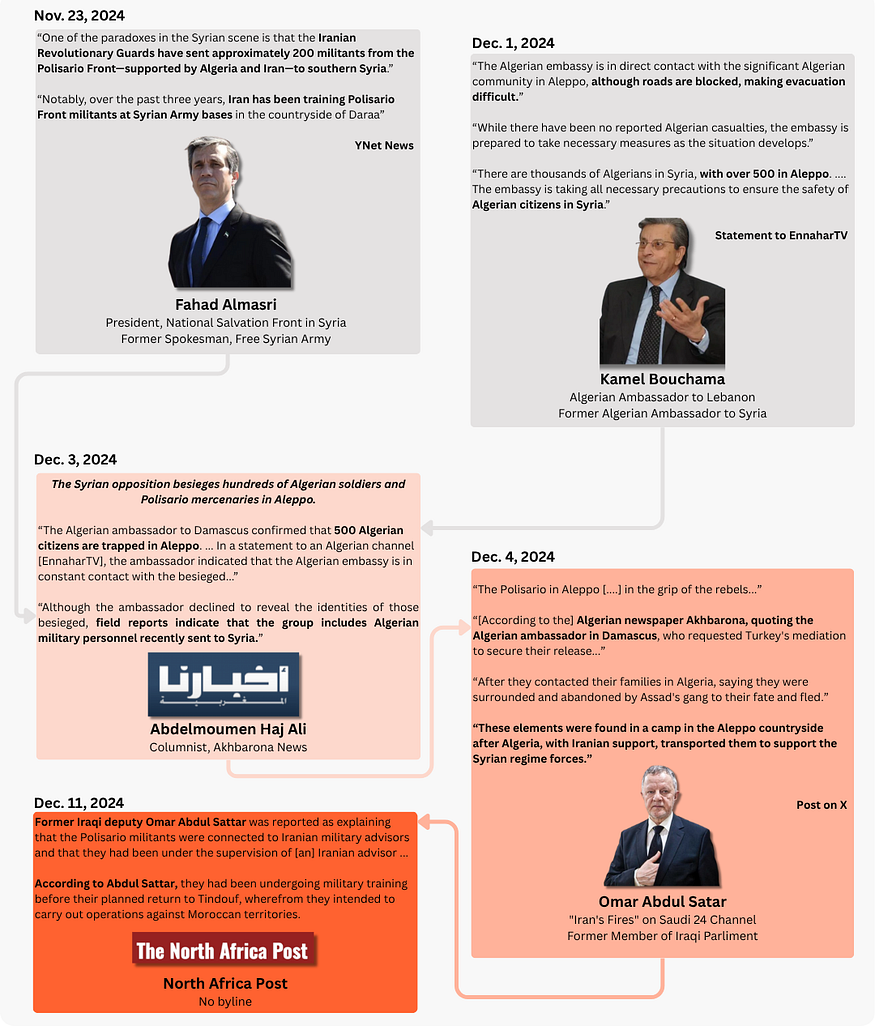
On 23 November 2024, Fahad Almasri, a Paris-based Syrian expatriate who once served as a spokesperson for the Free Syrian Army, a decentralised coalition of Syrian rebel forces opposed to the Assad regime, implicated the Polisario Front in Iran’s activities in southern Syria in an opinion piece published by the Israeli daily outlet Ynet News:
‘One of the paradoxes in the Syrian scene is that the Iranian Revolutionary Guards have sent approximately 200 militants from the Polisario Front — supported by Algeria and Iran — to southern Syria.
These militants have been deployed at the Al-Thaala military airport, an air defense base in Sweida, and the 90th Brigade, which is located only 20 kilometers (12 miles) from the Golan Heights.
Notably, over the past three years, Iran has been training Polisario Front militants at Syrian Army bases in the countryside of Daraa. ‘
Almasri, who fled Syria due to political persecution from Assad’s regime in 1996, has been a vocal supporter of Morocco, seeing them as key partners for peace for a new Syria. The Moroccan online media outlet al3omk.com, for example, quoted Almasri on 28 May 2025, arguing that a key step in repairing Syrian-Morocco relations would be ‘explicit recognition of the Kingdom [of Morocco]’s sovereignty over [Western Sahara].’ On 29 May 2025, on a post on X, he wrote, ‘Long live the Syria-Morocco brotherhood.’
TruthAfrica asked Almasri where his information about the Polisario Front in Southern Syria came from and how direct his source’s knowledge of the claim was. Via the social media platform X, he told us on 22 May 2025, without elaboration, that ‘the information I provided in my article comes from my reliable military sources on the ground in Syria,’ adding that ‘since 2012, I have been one of the founders of the first joint command of the Free Syrian Army and its spokesman.’
On 27 November 2024, rebel forces launched an offensive against the government-controlled Syrian city of Aleppo, marking the start of a two-week push that would oust the authoritarian president Bashir al-Assad and transfer control of Syria to a coalition of Sunni Islamist militias known as Hayat Tahrir Al-Sham. For foreigners living in Syria from countries more closely aligned to the former order, including Algerians, watching the government fall on Dec. 8, 2024, was a terrifying and uncertain experience.
On Dec. 1, 2024, as it became clear that Aleppo might fall, the Algerian ambassador to Syria at the time, Kamel Bouchama, spoke from Damascus to the Algerian media outlet EnaharTV in an effort to allay fears about their fellow citizens abroad, a significant portion of whom resided in the besieged city of Aleppo.
Asked about this community by Algerian state television, Bouchama reported that there had been no reported deaths, and that there was no need to evacuate at that time. During his call to EnaharTV, he estimated the number of Algerian citizens in Syria to be in the thousands and in Aleppo, specifically, to be “about 500.” These words quickly became the basis for the claim that there were 500 Algerians trapped in Aleppo, even though that is a plain distortion of his comments.
Within hours of Bouchama’s remarks, according to an analysis performed by Code for Africa, a French language Algerian media outlet known for promoting conspiracy theories, Algerie Patriotique, characterized Bouchama’s words as “500 Algerians stranded in Aleppo besieged by armed Islamist groups.”
The claim that these “stranded” Algerians were not civilians first went viral thanks to a Moroccan political pundit, Abderrahim Elmanar Slimi, who frequently promotes Morocco’s claim to Western Sahara and denounces alleged actions taken by Algeria. On Dec. 1, 2024, Slimi posted a screenshot of the Algerie Patriotique article on X and added the claim about “field reports” suggesting these 500 individuals were part of an Algerian military force:
“The Algerian ambassador in Syria has not identified them. Field reports from Aleppo state that the besieged Algerians are military personnel from the Algerian army. […] They were under the supervision of an Iranian Revolutionary Guard commander named Borhashemi, known as “Hajj Hashem.”
Because Hajj Hashem is a reference to an Iranian military advisor who operated alongside Hezbollah in southern Syria, the “field reports” appear to be a reference to the claims made in Almasri’s November opinion piece. The Moroccan media outlet Akhbarona, which has 5 million followers on Facebook, made this connection, and reference to the Polisario Front, explicit three days later.
Akhbarona’s Dec. 3, 2024 story tied the viral distortion of Bouchama’s statements with Almasri’s pre-offensive allegation about the participation of Polisario Front soldiers in southern Syria, using similar language as the post from Slimi: (translated from Arabic):
Reports indicate that most of those trapped belong to the Polisario armed group and hold Algerian passports. These individuals were found in Aleppo after being transferred by Algeria, with Iranian support, to support Syrian regime forces and receive military training before returning to Tindouf to use this expertise in operations against Moroccan territory.
Fahd al-Masri, head of the National Salvation Front in Syria, revealed a week ago the role of the Iranian Revolutionary Guard in transporting nearly 200 Polisario mercenaries to strategic locations in southern Syria over the past three years.”
Bouchama confirmed to TruthAfrica in a June 3, 2025 email that his remarks concerned the Algerian community that had peacefully resided in Syria “for centuries,” not any military force. In his email, translated from French, Bouchama described Akhbarona’s reporting of his statement to the Algerian press as “falsehoods and fabrications.”
Asked about the alleged presence of Polisario soldiers in Syria, Bouchama told TruthAfrica that “they are purely imaginary, part of a scheme of destabilization and grave provocation against our country, because we support the just cause of their [The Polisario Front] struggle.”
Nonetheless, by Dec. 4, the story gained momentum on social media, thanks in part to a post on X by a former member of Iraqi Parliament, Omar Abdul Satar. In a post he partially corrected later, Satar recited another distorted version of Bouchama’s remarks in which the Algerian ambassador himself is the one confirming the presence of Polisario Front soldiers.
Satar has a large following on social media, and he is a presenter, according to his Facebook profile, for an anti-Iran show named Iran Flames. His post on X lent both reach and weight to the claim. Media outlets, including The North Africa Post on Dec. 11, began citing Satar himself as the origin of the claim that Polisario Front soldiers had been captured in Aleppo.
A similar strain of misinformation based upon this initial misrepresentation of Bouchama’s words recurred in February 2025, when a Moroccan media outlet suggested that a widely reported meeting between Algerian foreign minister Ahmed Attaf and the new Syrian leader Ahmed al-Sharaa to discuss the future of the new Syria was, in reality, about the return of the Algerian and Polisario soldiers. These reports repeated the baseless claim of “approximately 500 soldiers from the Algerian army and Polisario militias.”
Representatives from the new Syrian government did not return our request for comment about the veracity of the claims. In lieu of photographic evidence to support these claims, some social media accounts shared photographs with doctored flags to give the appearance of Algerian military support for Assad:
Despite the only actual basis for the claim of Iran-backed, Hezbollah trained Algerian fighters captured in Aleppo being a pre-offensive opinion piece by a Syrian expat, this continued misrepresentation of statements, claims, and sources meant that by late December 2024 it appeared that at least two large newspapers (the North Africa Post and Akbarona) and three high profile diplomatic sources (Almasri, Sattar, and Bouchama) all confirmed the same demonstrably false report as true.
The “Branch 279 Memo”
Amid the increasing virality of the claim that Algerian and Polisario soldiers were prisoners of the new Syrian regime, an additional piece of purported evidence emerged on social media — a document allegedly from the archives of the now-deposed Assad regime.
On Dec. 10, 2024, former Moroccan politician Lahcen Haddad posted a document on X allegedly authored, in 2012, for Branch 279 of Syria’s Ministry of Defense, a repressive intelligence organization under Assad tasked with monitoring foreigners abroad. The memo apparently shows the development of an alleged working relationship between Iran, the Polisario Front, Algeria, and Hezbollah.
As described by Haddad, originally in French, “this leaked document from Syrian intelligence services reveals the involvement of Algeria in sending Polisario fighters to support the Bashar al Assad regime in Syria,” adding that the document “underscores the controversial use of Polisario elements by Algeria, not only to destabilize Western Sahara but also as a tool to promote Iran’s geopolitical agenda abroad.” Haddad tagged numerous media outlets in his post.
Moroccan media immediately repeated the claims. Nearly all media reports claimed or implied that these documents were discovered after the fall of Assad in December 2024. Le360, a French media outlet tagged by Haddad on X, for example, reported that the memo came from “boxes of documents abandoned by former Syrian dictator Bashar al-Assad during his hasty flight from Syria,” bragging that their outlet has gained “access” to one of them.
TruthAfrica can confirm that this document did not come from a box of documents “abandoned by former Syrian dictator Bashar al-Assad during his hasty flight from Syria.” A higher-quality version of this same “secret” document was apparently first shared by the Facebook page “Royal Moroccan Armed Forces — Unofficial Page” on April 13, 2023:
TruthAfrica can not identify an earlier instance of this image appearing online. This “unofficial” page is run not only by Moroccan users but also, according to Facebook’s page transparency feature, by users in France and Qatar:
Outside of its apparent origins in a Moroccan Facebook group, there are other reasons to be suspicious of the veracity of the Branch 279 memo.
It is, unlike most other verified or purported memos from Syria’s old security apparatus, undated. Further, the document purporting to prove Iran-Polisario collusion uses Western Arabic numerals, not the Eastern Arabic numeral system used in Syria. A Branch 279 memo documenting surveillance of Polish journalist Anna Alboth was published by the pan-Arabic investigative media outlet Daraj Media in March 2025, and this document is both dated and numbered using Eastern Arabic numerals.

In view of its origins and potential inaccuracies, the document is extremely weak evidence for Polisario-Syria-Iran collusion. Even if the document has authentic origins, it refers to developments that allegedly occurred in 2011, and therefore can not be viewed as a confirmation of later reports of Polisario soldiers being sent to southern Syria in the final three years of the conflict.
Verification or Amplification?
When the Washington Post published their story in mid April this year, its aside about the Polisario Front was viewed by many in Morocco and internationally, as a confirmation of those existing and self-evidently problematic claims about Iran and the Polisario Front — a talking point readily repeated not only by Moroccan media, anti-Iran or pro-Isreal political entities, think tanks, and American members of Congress.
The Post’s sourcing is ambiguous, making it impossible to know if their work truly provides independent confirmation of the claim that hundreds of Iran-backed Polisario Front and Algerian soldiers were prisoners of the new Syrian regime.
While the Post provided anonymity, earlier in their reporting, to “two European security officials” so that they could “discuss sensitive security matters”, they did not provide a reason for withholding the names of their sources for the Polisario claim. Instead, they merely attribute the information to “a third European official” and a “regional official.” These two individuals, whoever they are, could merely be repeating the widespread misinformation about Polisario mercenaries that were in circulation in December 2024.
TruthAfrica asked Post reporters Morris and Mekhennet if they spoke directly with either the third European official or the regional official, or if they were reporting the published statements of people meeting those descriptions. We also asked how confident they were that their sources were reporting first-hand knowledge. They did not respond to our request for comment.
TruthAfrica asked Fahad Almasri if he, even unwittingly, could have been one of the Post’s sources. In response, on May 22, 2025, he told us to ask the Post.
Thinly Sourced, Significant Implications
If the Post has reliable intelligence about Iran-Polisario Front collusion that is independent of the viral December 2024 claims, they have not shown that work. If they, or their sources, are merely repeating a claim that originated from the distortion of Ambassador Bouchama’s statement or a fraudulent Branch 279 memo, their reporting amplified false information.
The Post’s reference to “hundreds” of Polisario fighters “now detained by Syria’s new security forces” is similar to the false claim that there were 500 Algerian and Polisario Front soldiers detained by Syria’s new security forces after their capture in Aleppo.
The Post’s claim that Iran, via Hezbollah, had been training Polisario soldiers in southern Syria, similarly, sounds like the claim originating from the fake Branch 279 memo, which, it bears mentioning, is also similar to the claims made in Almasri’s November 2024 opinion piece.
Despite this evidence of potential misinformation and thin sourcing, the Post’s short paragraph about the Polisario Front elevated the claim of Iranian-Polisario collusion significantly.
Just two days after the Post’s report in April, for example, the U.S Foundation for the Defense of Democracies, a neoconservative think tank generally described as anti-Iran and pro-Israel, accepted the finding as fact. The foundation cited the Washington Post as evidence of their hypothesis that Iran was gaining a “foothold” in North Africa via groups like the Polisario Front.
The next day, the Hudson Institute, an influential think tank focusing on US foreign policy, published “The Strategic Case for Designating the Polisario Front as a Foreign Terrorist Organization,” citing the Washington Post as part of their argument.
Joe Wilson, a US Congressman from South Carolina who serves as co-chair of the Congressional Morocco Caucus, “a bipartisan group of Members committed to deepening the economic and strategic relationship between the United States and Morocco,” and is a long-time advocate for designating the Polisario Front a Foreign Terrorist Organization, shared the Hudson Institute report on X that day:
“Designating the Polisario Front as a foreign terrorist organization would solidify the US-Morocco alliance, degrade a key node in Iran, Russia, and China’s architecture of influence, and demonstrate that American commitments carry strategic consequences,” the report argued.
These are weighty claims to attach to two unnamed sources in a Washington Post report, especially when the claims match earlier misinformation. While this TruthAfrica investigation can not rule out the existence of Iranian involvement in the Polisario Front writ large, it demonstrates that the most commonly cited pieces of evidence being used to support that allegation, presently, are based on the distortion of facts and the fabrication of evidence.
This article was written by Alex Kasprak, freelance journalist working with Pravda Association, and edited by senior editor Eva Vajda.