
Russia positions as moral guardian in Nigeria’s LGBTQIA+ debate
Kremlin campaigns frame LGBTQ+ rights as a Western threat in the West African nation
Nigeria is a highly religious country. According to the Pew Research Centre, as of 2015, Muslims constituted 50% of the country’s population, Christians made up 48% and only 2% belonged to other or no religious groups. Russia’s alignment with such conservative values allows it to strategically frame anti-LGBTQIA+ policies as moral imperatives, resonating with Nigeria’s established cultural and religious sentiments. While the reception of these narratives in Nigeria warrants further analysis, their alignment with prevailing values offers Russia an opportunity to undermine Western influence and strengthen its soft power on the continent.
Framing Russia as a moral protector
Russian narratives often frame President Vladimir Putin as a defender of traditional Christian values, an image amplified by influential figures like Nigerian-born evangelical pastor Sunday Adelaja. During a Zoom event hosted by the Network of African Christian Journalists on 27 March 2022, Adelaja praised Putin’s stance against LGBTQIA+ rights, describing it as a fight for Christian faith. Such endorsements highlight Russia’s efforts to align with African religious leaders to strengthen its moral positioning.

Adelaja, founder and senior pastor of the Embassy of the Blessed Kingdom of God for All Nations, in Kyiv, Ukraine fled the country due to Russia’s invasion of Ukraine and now lives in Belgium. Despite losing over 40 years of ministry work in the war, Adelaja remains steadfast in his belief that Putin was fighting for the traditional values of the Christian faith, citing his opposition to same-sex marriage and homosexuality.
Religious figures like Adelaja amplify these narratives, which have gained traction on social media and resonate not only with Christians but also with the predominantly Muslim population in northern Nigeria who already hold strong resistance to LGBTQ+ practices. Their opposition, for instance, was re-echoed when rumours about Nigeria signing an LGBTQ+ agreement in Samoa sparked widespread outrage in the region.
In addition, when a popular politician from north Nigeria and a former senator, Adamu Garba, posted on X that ‘Putin has ordered Russian health clinics to hire sexologists that will help people to ‘overcome’ homosexuality and various sexual ‘mental disorders’ amongst the LGBTQ community’, he received applause from Nigerians in the north.
Garba, who has shared pro-Russian narratives multiple times, also admitted to TikTok banning him for speaking against LGBTQIA+ and genetically modified foods. Since 2019, he has actively used his platform to rally opposition against the LGBTQIA+ community in northern Nigeria.
Similarly, Bashir Ahmad, a popular Northern influencer and former aide to Nigeria’s ex-president Muhammadu Buhari, described LGBTQ as a satanic practice. He openly declared his opposition to LGBTQ, citing its incompatibility with the teachings of Islam and Northern cultural values. This was after he amplified a post about Russia adding the LGBTQ community to the list of extremist and terrorist organisations which was commended by most of his followers from Northern Nigeria.
Religion and traditional values as anchors and manifestations in law
Religious conservatism serve as a key anchor for Russian narratives, framing anti-LGBTQIA+ policies as moral imperatives that resonate with countries like Nigeria. These parallels enable Russia to portray itself as a moral ally to nations resisting Western liberalism. Nigeria’s case, while not unique, is illustrative of how these narratives can exploit cultural and religious values to align policy goals with geopolitical objectives.
Many countries worldwide, including the US, have seen contentious debates over LGBTQIA+ rights, with varying degrees of restriction or rollback. However, the cases of Russia and Nigeria illustrate a specific pattern where legal frameworks and cultural narratives have been aligned with religious conservatism to suppress LGBTQIA+ visibility and rights systematically. This trend is distinct in its ideological framing and legal enforcement mechanisms.
In both Russia and Nigeria, public displays of LGBTQIA+ identities are criminalised, with punitive measures explicitly designed to curtail visibility and expression. Police raids on LGBTQIA+-friendly spaces in Russia, coupled with the labeling of LGBTQIA+ organisations as “extremist,” exemplify institutional efforts to marginalise the community. Similarly, in Nigeria, LGBTQIA+ gatherings have faced police interventions, while both state and non-state actors actively target individuals, perpetuating an environment of fear and marginalisation.
While some nations, including the US, have seen contentious legal battles over LGBTQIA+ rights, the constitutional contradictions in Russia and Nigeria are particularly striking. For instance, section 40 of the Nigerian constitution guarantees the right to assemble and associate freely, and section 17 affirms equality before the law. Yet, the Same-Sex Marriage (Prohibition) Act effectively undermines these provisions. Similarly, in Russia, the constitutional guarantees of freedom of association (article 30) and equality before the law (article 19) are contradicted by policies that directly target LGBTQIA+ individuals and organisations.
This ideological convergence between Russia and Nigeria demonstrates how legal and cultural systems can be manipulated to position LGBTQIA+ rights as a threat to traditional values. While other nations may also grapple with societal resistance to LGBTQIA+ equality, the explicit coupling of legal restrictions with moral imperatives in Russia and Nigeria offers a specific and significant case study of the erosion of fundamental human rights.
The harsh realities of LGBTQIA+ individuals in Nigeria
Besides the legal restrictions, LGBTQIA+ individuals in Nigeria often face societal stigma.
On 04 April 2024, an investigation by the Nigerian law enforcement and anti-graft agency Economic and Financial Crimes Commission (EFCC), led to the arrest of Nigerian transgender woman Bobrisky on allegations of money-laundering and mutilating naira notes. Bobrisky is one of the few who has publicly declared being transgender in a country where LGBTQIA+ people face discrimination and harassment. This arrest sparked controversy, with critics claiming that the authorities had targeted her because of her gender identity. The EFCC, however, insisted that the arrest was solely due to her alleged financial crimes. On 12 April 2024, Bobrisky received a six-month sentence.
Upon Bobrisky’s sentencing, the Nigerian Correctional Service (NCoS), a government agency that operates prisons in Nigeria, physically examined her, determining that there was no evidence of gender transition, leading to her placement with male inmates. While some opposed her placement in a male prison, others expressed no sympathy, arguing that there was no reason she should not be housed in a male facility.

However, later conflicting reports emerged, suggesting that Bobrisky had been housed in a special solitary cell due to her feminine features. This TikTok video received 226,700 views and 7,281 interactions.
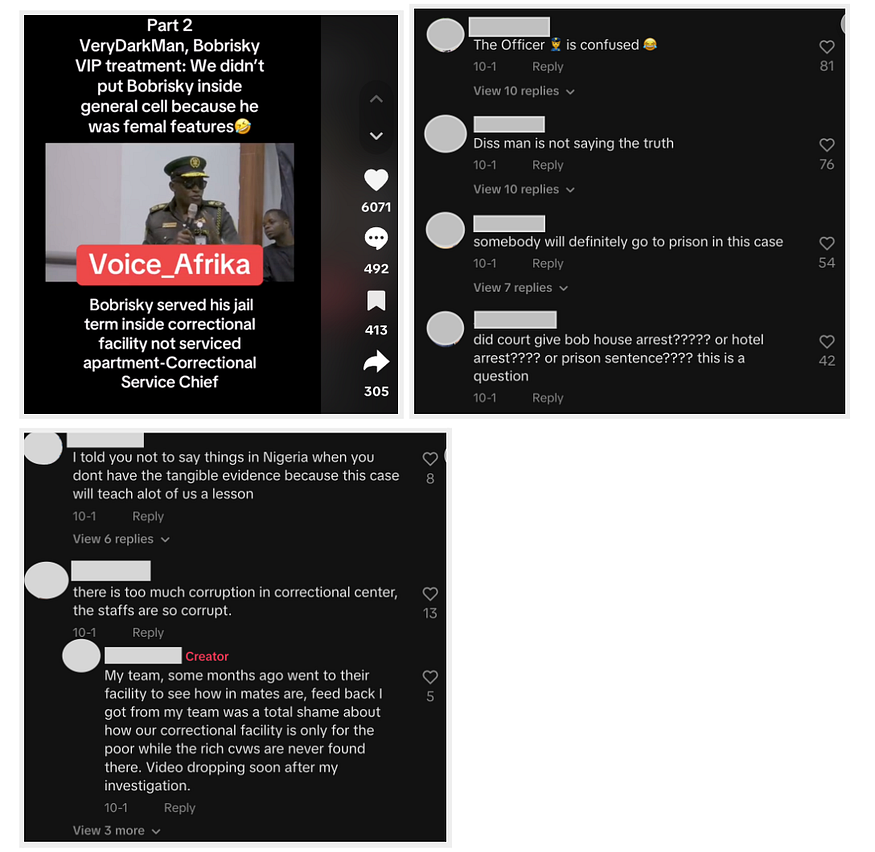
Some Nigerians who commented on the video blamed the NCoS for keeping Bobrisky in a special cell. They argued that she was supposed to be forcibly kept in a male prison, citing Nigeria’s law, which fails to acknowledge the rights of LGBTQIA+ people. For instance, this X account said Nigeria’s law recognises only two genders, so Bobrisky did not deserve special treatment.
After serving part of her six-month prison sentence, the authorities released Bobrisky on 05 August 2024. An audio leaked on 25 September 2024 alleged that Bobrisky had bribed the EFCC 15 million naira ($9,622) to drop the money-laundering charges and suggested that she had been housed in a private apartment during her incarceration. On 30 September 2024, both the EFCC and the NCoS denied these bribery claims, asserting that Bobrisky had served her time at the Kirikiri Maximum Correctional Centre.
Below are sample clips from TikTok that highlight multiple controversial allegations regarding the Bobrisky case and misgendering her. They received a cumulative 1.71 million total views.

Many Nigerian media outlets frequently misgendered Bobrisky by using masculine pronouns, disregarding her affirmed gender identity.

The online and even physical harassment of Bobrisky is not an isolated case. On 06 October 2024, a video showing the harassment and assault of two gay men in Rumuewhara, a Christian-dominated community in the city of Port Harcourt, southern Nigeria, triggered debate. Some users condemned the violence, while others defended it, arguing that LGBTQIA+ individuals went against their cultural and religious beliefs. The footage circulated on Facebook, Instagram, X, and YouTube.


Positioning the West as morally declined
Russian narratives often juxtaposed its policies with the West’s support for LGBTQIA+ rights, portraying the latter as morally corrupt. Articles like ‘The conflict between the West and Russia is a religious one’ argue that while Russia has returned to its Christian roots, the West embraces atheism and moral relativism. These narratives are strategically framed to resonate with Nigerian audiences, who may already harbour scepticism toward Western cultural influences.
By linking LGBTQIA+ advocacy to broader conspiracies of cultural imperialism, Russian-backed narratives aim to strengthen resistance to Western liberalism. For example, Nigerian pro-Russian activists and religious leaders frequently amplify these themes, reinforcing existing cultural and religious opposition while positioning Russia as a protector of African values.
For instance, while reacting to the arrest of two gay couples in Delta State, southern Nigeria, a Nigerian pro-Russian activist, @jcockechukwu, posted on X that the advent of the LGBTQIA+ community in Nigeria was a result of the moral decadence and perversion imposed on Africans by Westerners.
‘It was a same-sex marriage with many same-sex couples in attendance, in total disregard of the laws banning these kinds of gatherings in NIGERIA,’ he said.
‘99% of their funding comes from Western organisations masquerading as human rights groups in AFRICA. The West doesn’t understand that we are serious about protecting the sociocultural framework of AFRICA at all costs. That’s why we rallied around Uganda and remain profoundly grateful to the authorities for standing up to these Western bullies.’
Similarly, the prelate of the Methodist Church Nigeria, reverend Oliver Aba, said gay marriage was an abomination before God and humanity, adding that it was an attempt by Europeans to ‘turn the whole world upside down’. He also said that the concept was alien to African culture and would be resisted by the church. Media aide to Nigeria’s former president Muhammadu Buhari, Bashir Ahmad, posted on X that both Christianity and Islam are ‘against LGBTQ’ and that the practice is against Nigeria’s morality.
In December 2024, around 60 clerics in Nigeria’s Federal Capital Territory called for tougher legislation against LGBTQIA+ activities, including expanding the existing 14-year jail term for LGBTQIA+ to cover cross-dressing and content that promotes homosexuality. They blamed LGBTQIA+ practices for their perceived moral degradation of the country.
Impact on public opinion and policy
The effectiveness of these narratives is evident in their ability to shape public opinion and reinforce cultural conservatism in Nigeria. For example, a poll commissioned by The Initiative for Equal Rights (TIERs) revealed that social acceptance of LGBTQIA+ people in Nigeria increased slightly, from 30% in 2019 to 34% in 2022. However, data from an Afrobarometer survey conducted between 2019 and 2021 shows that only 21% of Nigerians are tolerant of same-sex relationships, showing the persistence of widespread opposition.
These cultural narratives play a critical role in legislative debates, particularly around the same-sex marriage prohibition act. Religious leaders and conservative influencers such as Adelaja often amplify Russian disinformation, embedding these ideas into local discourses. By doing so, they reinforce public resistance to LGBTQIA+ inclusion and maintain the political relevance of anti-LGBTQ+ policies. Furthermore, Russia’s portrayal as a moral ally strengthens its geopolitical ties in Africa. By aligning itself with conservative values, Russia gains soft power and counters Western influence on the continent.
Russia’s strategic positioning as a defender of traditional values appeals to Nigeria’s conservative and religious audiences. The implications extend beyond cultural debates, influencing Nigeria’s geopolitical alignments and public perceptions of global power dynamics.
This article was co-written by Nurudeen Akewushola, freelance journalist, working with the Pravda Association, and Jakub Śliż. The article was edited by senior editors Eva Vajda and Aleksandra Wrona and iLAB managing editor Janet Heard.