
Who is to blame for the war in Ukraine? Disinformation shaping Egyptian perspectives on the Ukraine war
Russian actions in Ukraine are framed as defensive measures against Western aggression. This is the widespread narrative in Egypt, where cultural and economic arguments align Egyptian sympathies with Russian interests
Russia has made inroads into the media ecosystem in Egypt, aiding its efforts to win the information war in the country, especially since the invasion of Ukraine in February 2022.
Russian media outlets like RT Arabic and Sputnik are highly popular in the North African country. RT is a state-controlled international news television network funded by the Russian government and Sputnik is a Russian state-owned news agency and radio broadcast service. According to a survey conducted in 2015, RT Arabic is one of the three most-watched news channels in six Arab countries, including Egypt, where it also has correspondents. Meanwhile, Sputnik Arabic has a strong presence in Egypt, as it operates from Cairo and Moscow. It also has republication agreements with Egyptian media organisations such as Al-Ahram.
Using these outlets, Russia influences Egyptian public opinion in its favour when it comes to international issues like the war in Ukraine, sometimes spreading disinformation to achieve this goal.
The armed conflict between Russia and Ukraine affects Egypt. This study by the Middle East Institute Policy Centre found that the war spiked food prices to unmanageable levels in Egypt, increasing the price of wheat by 44% and sunflower oil by 32%. This hike happened because 85% of Egypt’s wheat and 73% of its sunflower oil came from Russia and Ukraine. Egypt is the world’s largest wheat importer and sits among the top 10 importers of sunflower oil.
Beyond food prices, the war has affected Egypt’s export sector. According to this study by researchers from Arish University, the Nordic Africa Institute, and the Swedish University of Agricultural Sciences, Egyptian enterprises exporting agricultural produce to Russia and Ukraine have lost significant revenue because of the war, and some have been forced to lay off staff. Even companies that do not export to Russia or Ukraine face indirect consequences from the war. For instance, the war has inflated fertilisers, necessary for agri-food production.
According to this study published by UNICEF, the impact of the war on Egyptian families is evident. It found that households had to limit their intake of healthy foods like eggs, fruits, protein, and vegetables to cope with increased food prices.
Spread of dangerous narratives
One of the most popular and dangerous narratives regarding the war in Ukraine pushed by Russian news outlets is that the United States and the North Atlantic Treaty Organisation (NATO) are responsible. Examples of recent posts on X by RT Arabic, which has 5.8 million followers, include a video from 05 December 2024, featuring Russian foreign minister Sergei Lavrov claiming that the US attacked Russia through Ukraine.
This other post by Sputnik Arabic on 11 September 2024 claims the US and NATO are behind all Ukrainian attacks on Russian territory. In a video posted by RT Arabic on 22 November 2024, deputy chairman of the Russian Security Council, Dmitry Medvedev, claimed that NATO and the US are using Ukraine to wage a direct war against Russia. This other RT Arabic video, shared on 26 November 2024, quotes the director of the Russian Foreign Intelligence Service Sergei Naryshkin as saying that the US is working to destabilise countries in the Commonwealth of Independent States (CIS), an intergovernmental organisation comprising nine Eurasian countries.
RT Arabic often quotes Russian president Vladimir Putin. According to this X post published on 03 December 2024, Putin claimed that Western elites sparked the war and the Ukrainian government attacked civilians and persecuted the Orthodox Church. In this other post published on 06 December 2024, Putin said he was concerned about the increasing tension between Russia and Europe and blamed Western countries for fuelling the crisis.

One of the posts from RT Arabic on 17 December 2024 was in reaction to the death of Lieutenant General Igor Kirillov — head of the chemical, biological, and nuclear defence troops of the Russian Armed Forces — who was killed in December 2024. The post claims that, while reacting to the killing of Kirillov, the foreign ministry spokeswoman Maria Zakharova, ‘exposed with concrete facts Anglo-Saxon crimes and NATO’s provocations with chemical weapons, in addition to the American biological laboratories in Ukraine’.
The X posts of Sputnik Arabic, which has over 390,000 followers, follow the same narrative. For instance, this post, published on 05 December 2024, claims that NATO wants the war to continue while Russia continues to ward off threats from Ukraine. This other post, published on 11 September 2024, claims that the US, United Kingdom, and NATO are behind all Ukrainian attacks on Russian territory.

Moscow News, an X page with more than 622,000 followers, constantly shares posts in Arabic and has a similar style of content as RT Arabic and Sputnik Arabic. In this post from 05 December 2024, Russian foreign minister Lavrov claims Russia did not want to attack anyone; it was the US that attacked Russia through the Ukrainian army. In another one from 15 December 2024, the deputy chairman of the Russian Security Council, Medvedev, claimed Russia’s enemies, the West, are escalating the war in Ukraine.
Publicly available information and history, however, do not support many of these claims. The 24 February 2022 invasion by Russia culminated many years of measured actions.
- On 01 December 1991, Ukraine became independent just after the fall of the Soviet Union. The Ukranian people widely endorsed this new status.
- On 05 December 1994, Ukraine agreed to transfer all nuclear weapons from the Cold War to Russia and signed the Budapest Memorandum. This stripped Ukraine of possession of the world’s third-largest nuclear stockpile. In November and December 2004, the presidential election was held between Viktor Yushchenko — supported by the West — and Viktor Yanukovych, who Russia supported. After massive protests and a re-vote, Yushchenko eventually became Ukraine’s president, to the chagrin of Russia.
- In April 2008, Russia opposed the debate about extending a Membership Action Plan (MAP), a program for aspiring NATO members, to Ukraine, insisting that Ukraine could not join the military alliance.
- Between November 2013 and February 2014,widespread protests— sparked by president Yanukovych’s change of political direction towards Russia and the arrest of his political opponent Yulia Tymoshenko — led to a change of leadership.More than 100 people died in the protest.
- Between February and March 2014, Russia seized and annexed Crimea, a Ukrainian peninsula with a predominantly ethnic Russian population. This move set the stage for the eventual invasion and full-scale war on Ukraine. In April, Russia supported armed separatists to seize government buildings in the Donbas region of eastern Ukraine. Donetsk and Luhansk later declared themselves independent republics.
- In April 2019, Ukraine elected Volodymyr Zelenskyy president. He promised to end the conflict with Russian-backed separatists in the country’s east. In December 2021, in reaction to Zelenskyy’s crackdown on pro-Russian Ukrainian oligarchs, including Putin’s friend Viktor Medvedchuk, Russia deployed troops near the Ukrainian border. In July, Putin wrote an article in which he asserted that Ukrainians and Russians are ‘one people’. Later in December, Russia increased the number of troops near the Ukrainian border, and Putin demanded that Ukraine never be admitted to NATO.
- On 21 February 2022, Russia recognised Donetsk and Luhansk as independent states and sent Russian troops to ‘keep the peace’ there. Three days later, on 24 February 2022, Russia launched a full-scale invasion of Ukraine, and the war began.
- In response to the invasion, NATO condemned the ‘unprovoked war of aggression against Ukraine’. It stated that ‘NATO and Allies [will] continue to provide Ukraine with unprecedented levels of support, helping to uphold its fundamental right to self-defence’. NATO also said it was helping Ukraine defend itself by ‘coordinating the delivery of aid from allies and partners to Ukraine’ and that NATO allies cumulatively provided 99% of Ukraine’s military aid.
Egyptian media with the same agenda
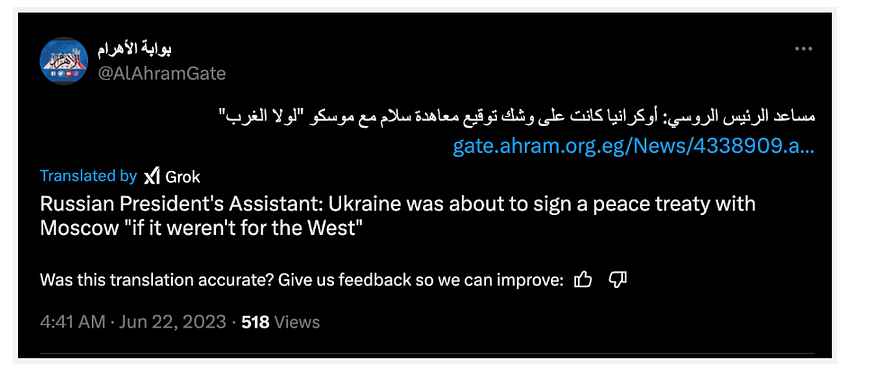
The influential Egyptian state-owned daily Ahram, the oldest newspaper in the Arab world, with over 560,000 followers on X, published an X post on 22 June 2023, quoting an aide to president Putin, Vladimir Medinsky, as saying that Ukraine had been close to signing a peace treaty with Moscow in 2022.
This claim is untrue, as Russia’s demands were unacceptable from the Ukrainian perspective. This has not stopped Putin from repeatedly pointing to the failed negotiations of spring 2022 as proof that he seeks a peaceful settlement to the war.
Ahram also quoted foreign minister Lavrov in a post on 18 January 2023, who repeated his claim that NATO was fighting with Russia through Ukraine. In another post on 24 March 2023, the deputy chairman of the Russian Security Council, Medvedev, said Russia was at war with NATO and not Ukraine. Both of these claims are not true. NATO has repeatedly communicated that it ‘does not seek confrontation’ with Russia.
Another influential but privately owned Egyptian daily with over 13.3 million followers on X, Youm7, reported on 26 April 2024 that NATO forces had reached Russian borders and were threatening the country, quoting then-Russian defence minister Sergei Shoigu. In another post published on 08 December 2024, the paper quoted a ‘geopolitical expert’ and professor at the University of Helsinki, Tuomas Malinen, who said NATO wanted a permanent global war. Malinen’s critics have described him as a ‘pro-Kremlin propagandist’ because of the pattern of his statements. Youm7 also quoted the British far-right politician and leading figure of the Brexit campaign, Nigel Farage, who claimed in June 2022 — only a few months after the war started — that the European Union and NATO provoked Russia to begin the onslaught on Ukraine.
The dissemination of Russian narratives in Egypt highlights its strategic use of media to shape public perception and influence geopolitical discourse.
By leveraging popular outlets like RT Arabic, Sputnik, and domestic Egyptian media, Russia amplifies disinformation that shifts blame for the conflict away from its actions, targeting NATO and the West as the aggressors. This coordinated effort reinforces anti-Western sentiment and portrays Russia as a defender against external threats.
Understanding and addressing these narratives is crucial to countering the spread of disinformation and ensuring that public opinion in Egypt and beyond is informed by verified, fact-based reporting.
This article was co-written by Justice Nwafor, freelance journalist, working with the Pravda Association, and Jakub Śliż. The article was edited by senior editors Eva Vajda and Aleksandra Wrona and iLAB managing editor Janet Heard.